
In a nutshell: If you start small, the honest worst case is that you lose a bit of time and a small amount of money you’d already decided you could spare, and you come away knowing far more than you did. Fear shrinks when you set a spending limit, try one thing at a time, and give it a fixed trial period.
I want to start with something nobody really says out loud: most people who never start an online business aren’t lazy.
They’re scared.
Scared of wasting money. Scared of getting it wrong. Scared of people finding out. Scared of trying, and it not working, and then having to admit it didn’t work.
I know, because I sat with all of those for a long time. Wondered what I would say if anyone found out that I wanted to try something new, worried that if I decided to pay for something that didn’t work I would end up being a failure, worried about having to ask family and friends to build a team, (Yeah already been there and done that), so couldn’t do that again. I have been where you are, so I know exactly how you are feeling right now.
So let’s do the thing fear hates. Let’s actually look at it.
Why starting feels so scary
Fear is usually bigger when it’s vague. “What if it all goes wrong?” feels huge because you haven’t said what “wrong” means. Once you write it down, it normally gets a lot smaller.
There’s also the fact that you’ve probably seen the loud side of the internet: people promising the world, flashy screenshots, big claims. If that’s your picture of online business, of course you’re wary. That isn’t what most of us are doing, though.
The five fears I hear most (and what’s really behind them)
“I’ll lose money”
This is the big one. The answer is to decide your limit before you start. Not during, not when something shiny pops up. Before. Many beginner programmes have a free level, so your limit can genuinely be nothing for the first few months.
“I won’t understand the tech”
Most beginner setups need far less tech than people think. If you can send an email and fill in a form, you can do the basics. I’ve written a whole post on the tech you actually need.
“People will judge me”
Some might. Most won’t notice, honestly. And you can do a lot of this without your face, your name plastered everywhere, or telling everyone you know.
“It’ll be another thing I start and don’t finish”
This one’s about past experience, and it’s fair. It’s why I’d always say pick one thing and give it a fixed trial, rather than trying three things at once.
“I’ll get taken in by something dodgy”
A healthy amount of suspicion is a good thing. Check who runs it, read the small print, and never pay for anything in a rush. I’ve written about red and green flags to look for.
What’s the real worst case?
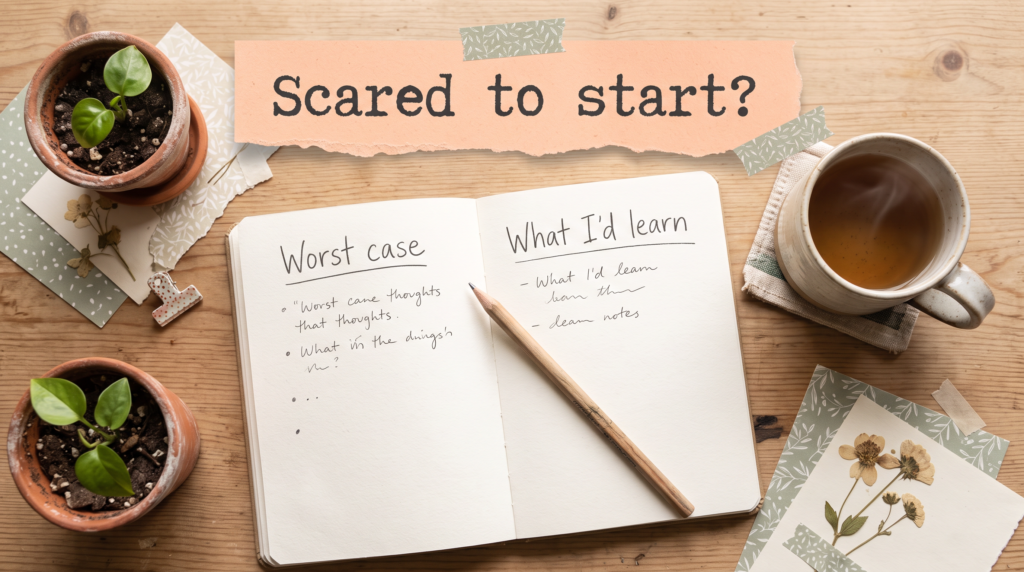
Here’s an exercise I found really useful. Grab a notebook and draw two columns.
| Worst case if it doesn’t work | What I’d still have |
|---|---|
| I’ve spent a few hours a week for three months | I’d know how email lists, funnels and affiliate links work |
| I’ve spent the small amount I set aside (or nothing) | A clear answer, instead of “what if” forever |
| I feel a bit daft for a week | Skills I can use for the next thing |
When I did this, I realised the worst case was… fine. Disappointing, maybe. But fine. What actually scared me more was being in the same place a year later, still wondering.
How to start small enough that it doesn’t feel scary
- Set a spending limit and write it down. Zero is a perfectly good limit to start with.
- Pick one programme. Just one. Ignore everything else for now.
- Give it a fixed trial. Three months is a good length. Long enough to learn, short enough to feel manageable.
- Do one small step a day. Some days that’s 10 minutes. It still counts.
- Tell one person, or nobody. You don’t need an announcement. You can share when you’re ready.
What helped me finally start
What finally got me going wasn’t a burst of confidence. It was finding something with a free starting point and a clear order of steps, so I didn’t have to work it all out myself.
For me that was the ClickBank Profit Club. The free level gave me a ready-made funnel, emails already written and training in order. I could log in, see step one, do it, and log out. No big leap. Just small steps, one at a time.
It wasn’t instant, and it still takes work. But it was a start I could actually manage.
If you’d like to have a look without committing to anything, you can join free and just poke around first:
Have a look inside the ClickBank Profit Club
Quick questions
Is it normal to be scared of starting an online business?
Yes, completely. Most people worry about wasting money, looking silly or failing. Feeling nervous usually means you care about getting it right, not that you shouldn’t start.
What happens if my online business fails?
If you start small, the realistic worst case is that you lose some time and a small amount of money you’d already decided you could afford, and you learn a lot. Very few beginner setups are hard to walk away from.
How can I start an online business without risking too much?
Start with free options, set a firm spending limit before you begin, try one thing at a time, and give it a set period, say three months, before deciding whether to carry on.
How do I stop overthinking and just start?
Pick one small first step you can do in under 30 minutes, such as creating a free account, and do only that.
Starting small takes most of the fear out of it.