
In a nutshell: You don’t need to be good at selling to do affiliate marketing. The approach that works best for beginners is closer to recommending: share useful content, tell people honestly what you’ve tried, say who it suits and who it doesn’t, and let them decide. No pressure, no pushing.
If you’ve ever had someone corner you at a party about a “business opportunity”, you’ll know why so many people hate the idea of selling. That feeling of being pushed. The forced smile. The not-taking-no-for-an-answer.
When I started, I was terrified I’d turn into that person. I’d rather have done nothing at all.
Here’s what I learned: the affiliates I actually trusted weren’t doing that. They weren’t really selling. They were helping.

Why selling feels so uncomfortable
Most of us link “selling” with pressure. Being chased. Feeling like a target. So when we imagine doing it ourselves, we imagine doing that to our friends, and naturally we cringe.
But that’s only one way to do it, and frankly it’s not a very good way. People are wise to it.
Recommending vs selling: what’s the difference?
| Selling (the bit we hate) | Recommending (what actually works) |
|---|---|
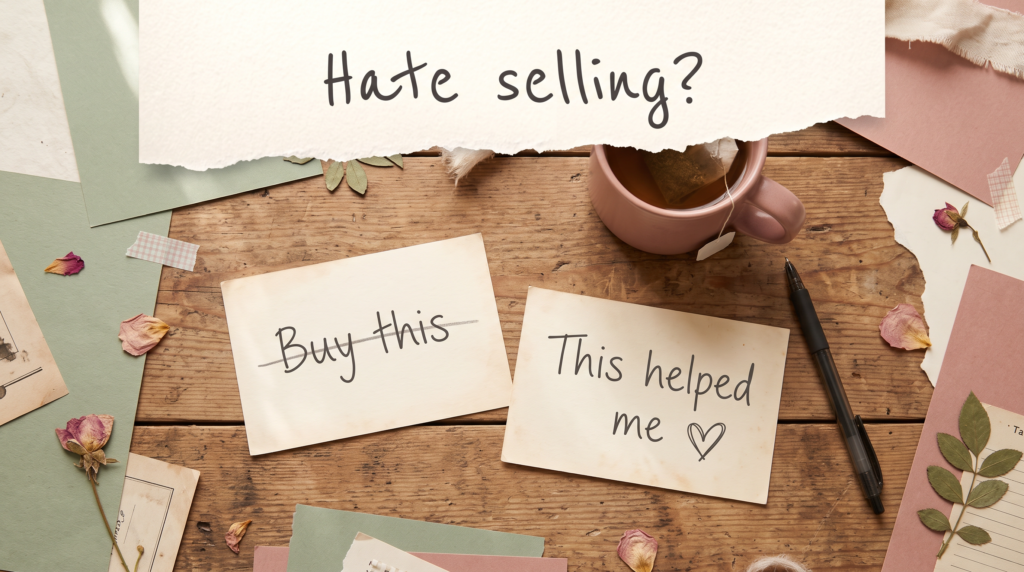
| “You need this” | “This is what helped me” |
| Only talks about the good bits | Says who it’s not for, too |
| Fake deadlines and pressure | Take your time, it’ll still be there |
| Every post has a link | Most posts are just useful |
| Chases people in messages | Lets people come to you |
You already recommend things all the time. A good film, a recipe, a shop that’s got a sale on. You don’t feel salesy doing that, because you’re sharing something you liked with someone who might like it too. Affiliate marketing done honestly is the same, just with a link.
What to say instead of a sales pitch
Here are a few ways I talk about things I’m an affiliate for. Pinch any of them and make them your own:
- “I’ve been using this for a couple of months. Here’s what I like and the bit I found tricky.”
- “If you’re a complete beginner, this is the one I’d start with. If you’re already experienced, you might not need it.”
- “No pressure at all. The link’s in my bio if you want a look.”
- “Happy to answer questions if you’re not sure whether it’s for you.”
Notice there’s no “act now” and nothing pretending to be a once-in-a-lifetime chance. My hype words post has more swaps like this.
Give more than you ask
The simplest rule I follow: most of what I share has no link at all. Tips, mistakes I’ve made, things I’ve learned. Then, now and again, I mention what I use.
Because I’ve been helpful first, mentioning a link doesn’t feel like a pitch. It feels like the natural next step for anyone who wants it.
The mistake I see so many people do is push the link in every social media post, this doesn’t help your post it just make it look like a sales pitch, and people need to get to know you first, they never buy from a stranger…
Let email do the gentle part
One thing that took a lot of pressure off me was having an email list. Instead of trying to convince people in a single post, I invite them to grab a free gift. Then my emails help them over the following days, and mention what I use along the way.
Nobody’s cornered. People read at their own pace, and they can unsubscribe whenever they like. It’s about as far from a hard sell as you can get.
The ClickBank Profit Club’s free level gives you this setup ready-made: a series of emails already written that you send from your own account. So the “selling” is really just helpful emails going out to people who asked for them.
Have a look at the ClickBank Profit Club
Quick questions
Do you have to be good at selling to do affiliate marketing?
No. Most successful beginners focus on being helpful and honest rather than salesy. You share what you’ve used and why, and people decide for themselves.
How do I promote affiliate links without being pushy?
Lead with useful content, share your real experience, mention the link once, and never use pressure tactics like fake deadlines. Let people come to it in their own time.
What’s the difference between selling and recommending?
Selling focuses on getting someone to buy. Recommending focuses on whether it fits them. A recommendation includes who it’s not for, which is exactly why people trust it.
Will people think I’m only trying to sell to them?
Not if most of what you share is genuinely useful with no link at all. A good rule is to give far more than you ask.